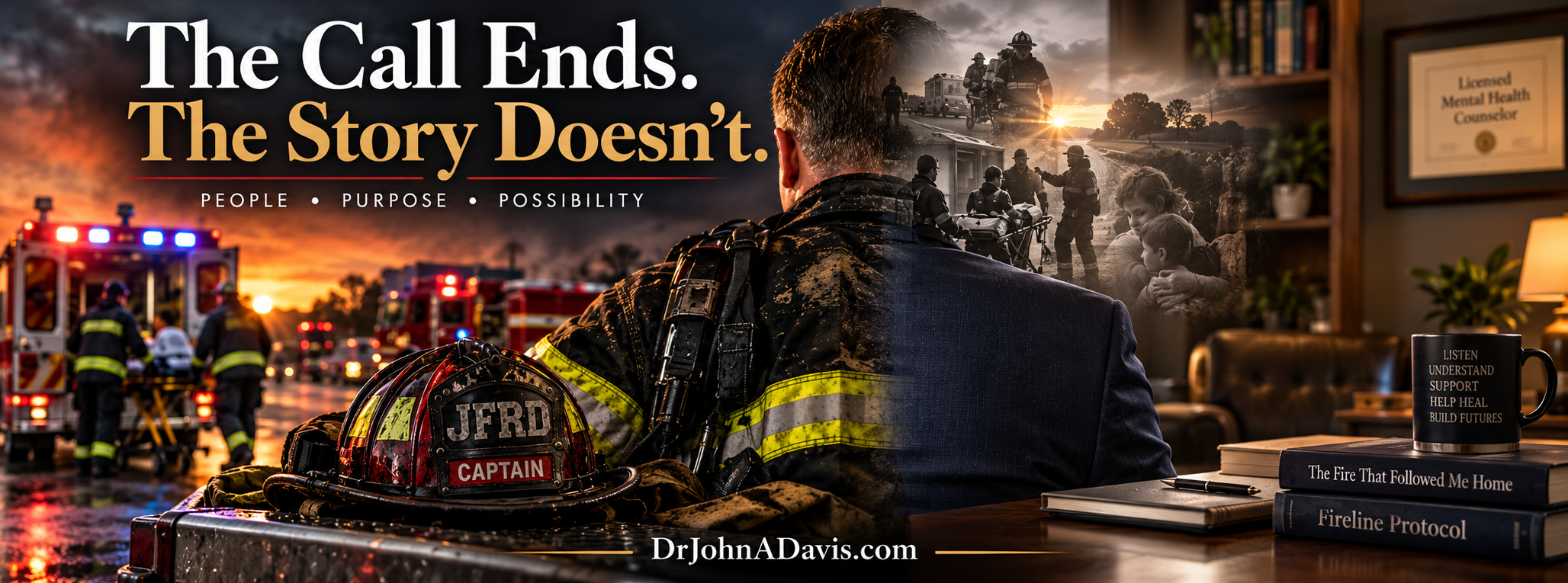
The radio falls silent.
The ambulance is cleaned and restocked.
The hose is rolled.
The equipment is back on the apparatus.
The report is complete.
The next call is waiting.
From the outside, the emergency is over.
But for many people, the story is just beginning.
For the patient, recovery may take weeks, months, or years.
For a family, life may never look quite the same.
And for the firefighter, paramedic, police officer, dispatcher, or emergency department clinician who answered the call, part of that day may quietly follow them home.
I know because it followed me.
Some Calls Stay With You
For years, I served as a firefighter and paramedic. Like everyone in this profession, I learned to focus on the job in front of me. Assess the patient. Manage the scene. Make decisions. Solve the problem. Move to the next assignment.
That discipline saves lives.
When someone calls 911, they deserve professionals who can remain calm while everything around them is falling apart.
But the ability to perform under pressure tells us very little about what happens after the pressure is gone.
Some calls stay with you.
A pediatric arrest.
A fatal crash.
A line-of-duty death.
A suicide.
A family saying goodbye.
Sometimes you remember every detail. Sometimes you remember only a face. Sometimes you don't realize a call affected you until years later, when something unexpectedly brings it back.
Not every difficult call becomes a lifelong burden. We should be careful not to assume that it will. But we should be equally careful not to assume that someone is unaffected simply because they finished the shift, laughed around the firehouse table, or came back to work the next morning.
What Follows the Emergency
The fire service teaches us how to manage emergencies. It doesn't always teach us how to process them.
That realization eventually led me into professional counseling.
As a therapist, I now meet people at a different point in their story. The emergency has ended. The sirens are gone. The paperwork is complete. But they are still trying to understand why they cannot sleep, why they are more irritable at home, why certain sounds trigger memories, or why they no longer feel like themselves.
I've learned that the hardest part of many emergencies isn't always what happened on scene. It's what follows afterward.
The Story Is Not Unique to Responders
This experience is not unique to first responders. Patients carry it. Families carry it. Survivors carry it. Spouses carry it. Children carry it. Leaders carry it.
Sometimes the people who appear strongest are quietly carrying the heaviest stories.
That truth has shaped everything I've written.
In my memoir, The Fire That Followed Me Home, I share the personal side of a career that didn't always stay at work.
In Fireline Protocol, fiction allows me to explore what happens when people who are trained to move toward danger must confront the consequences that remain long after the action ends.
Firefighting. EMS. Behavioral health. Writing.
At first glance, they seem like very different chapters of my life. To me, they've always been connected by one question:
What happens after people have done what the moment required of them?
Leadership After the Incident
The answer matters.
Because leadership doesn't end when the incident is terminated.
Great leaders understand that some conversations happen days or weeks later. A genuine check-in is not about forcing someone to talk. It is about letting them know someone is willing to listen.
Departments should ensure their members know what support is available, how to access it, and that asking for help is viewed as professionalism, not weakness.
For responders, it means recognizing that being highly capable and deeply affected can both be true.
The strongest people I have known were not those who never carried difficult calls. They were the ones who eventually found healthy ways to carry them.
For Families
For families, it means understanding that coming home is not always the same as arriving emotionally.
Sometimes the most meaningful question isn't, “What's wrong?”
It's simply,
“I'm here when you're ready.”
Not every difficult experience can be resolved with one conversation. But almost every healing journey begins with one.
The emergency may end when the apparatus returns to quarters. The report may be complete. The scene may be cleared. But the people who answered the call continue living their lives.
Their story deserves our attention, too.
Dr. John A. Davis III, PhD, LMHC
Retired Firefighter Captain/Paramedic
Author · Licensed Mental Health Counselor · Speaker